3lb Roofing Foam · Grizzly HD · Flat & Low-Slope
Spray foam roofing in Winnipeg
Direct answer
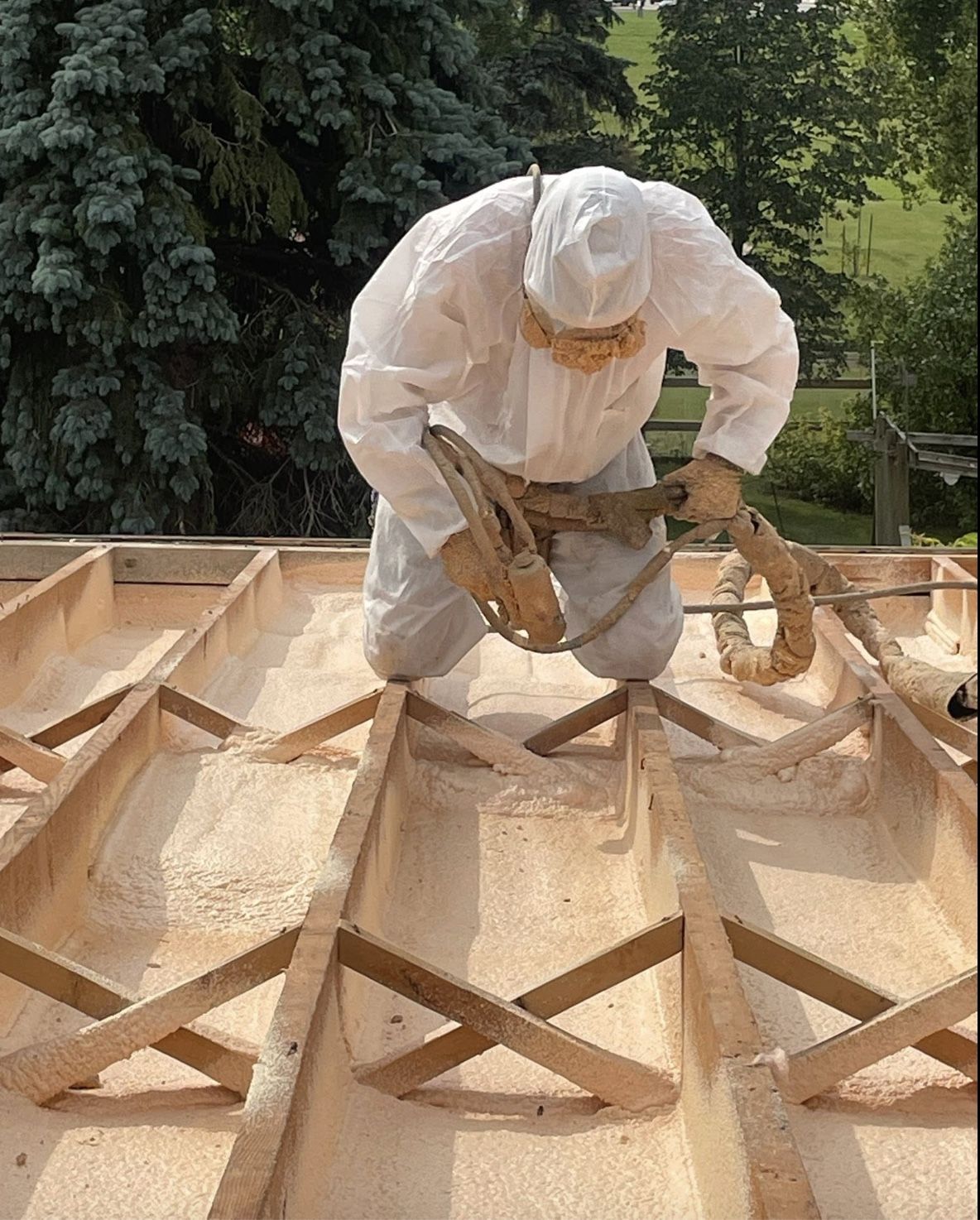
A spray foam roof is a seamless layer of 3lb polyurethane foam applied directly to a flat or low-slope roof deck, finished with a protective coating that takes the UV and the weather. The foam is fully adhered, with no fasteners, seams or laps. It flashes itself around curbs, drains and penetrations, and it can be built up to correct ponding by re-establishing slope to drain. It insulates while it waterproofs. Ecologic installs the Grizzly HD roofing foam from the same Canadian manufacturer as our wall foams, on commercial, industrial and agricultural buildings across Manitoba. It is a flat-roof system: if your building has steep-slope shingles, this is not your product, and we will say so on the phone.
Sources: manufacturer technical data · CUFCA · industry practice (SPFA)
01 The system
One monolithic layer. No seams to fail.
Every conventional flat-roof system (BUR, modified bitumen, EPDM, TPO) is an assembly of sheets. Sheets mean seams, laps and fasteners, and that is where flat roofs leak. A foam roof has none of them.
Fully adhered. The foam bonds chemically to the substrate across the entire surface. Wind can't get under it, and water that finds a coating breach can't travel laterally under the roof the way it does under loose-laid membrane. Leaks stay where the damage is, which makes them findable.
Self-flashing. The gun carries the foam up curbs, around rooftop units, pipes, drains and parapets in one continuous application. The usual flat-roof failure points, terminations and penetrations, become the same monolithic material as the field.
Slope-to-drain built in. Because the material is applied in liquid passes, we can build thickness where the deck sags and feather it toward drains. Ponding water, the standing enemy of every flat roof, gets engineered out rather than tolerated.
Insulation included. The foam layer is high-R insulation as well as the waterproofing plane, applied on the outside of the deck where it keeps the structure warm and dry.
The product we spray
Grizzly HD Roofing
The 3lb high-density roofing foam in the Grizzly line, made in Ontario by CUSE, the same Canadian manufacturer as the 2lb closed-cell (CCMC 14133-L) and 0.5lb open-cell foams Ecologic is licensed to install. Higher density means higher compressive strength: a roofing foam is walked on, hailed on and loaded with snow, and it is formulated for that duty.
Installed by CUFCA-certified installers with daily self-tests verified by third-party audits.
Where it goes
Commercial flat roofs · industrial buildings · agricultural and shop buildings with flat or low-slope decks: steel, wood, concrete, or sound existing roofing.
02 The Manitoba problem
Freeze-thaw is what kills flat roofs here
Winnipeg is a 5,670 heating-degree-day city that also hits +30° in July. Flat roofs live through that entire swing, every year.
Every spring and fall, meltwater sits on the roof by day and freezes by night. Water that has crept into a membrane seam or under a flashing expands as it freezes and pries the assembly apart, a little at a time. Thermal cycling works the seams and fasteners loose. Ponded areas carry the worst of it, because that is where the water waits.
A foam roof answers each mechanism directly. There are no seams for ice to pry. The insulation sits above the deck, so the structure itself stays out of the freeze-thaw zone. And slope-to-drain correction removes the standing water that feeds the cycle. The coating still weathers; nothing on a Manitoba roof is maintenance-free. But the failure modes that end conventional flat roofs are designed out of the system instead of patched every spring.
03 Recover vs tear-off
The substrate decides. Not the salesman.
When a recover works
Foam's ability to go over an existing roof — BUR, mod-bit, metal, sound single-ply — is a real economic advantage: no tear-off labour, no disposal, no days with the building open to the sky. The conditions are strict, though. The existing roof must be dry, well adhered, and on a deck that is structurally sound.
So we test before we quote. Moisture survey or core cuts to find trapped water in the existing insulation. Adhesion checks on the existing surface. A look at the deck from below where access allows. If the roof passes, the recover is legitimate and the savings are yours.
When tear-off is the honest answer
Foaming over a wet roof seals the water in. Trapped moisture keeps degrading the old assembly, corrodes steel decks from above, and comes back as blisters and adhesion failure in the new system. Every one of those outcomes costs more than the tear-off would have.
If the moisture survey finds saturated areas, the wet sections come out; sometimes that is a partial tear-off of the bad zones rather than the whole roof. You get the survey results with the quote, so you can check the recommendation yourself.
04 Coatings
The coating takes the weather. That's the deal.
Polyurethane foam is not UV-stable — leave it bare and sunlight chalks the surface within weeks. Every foam roof is therefore a two-part system: the foam does the waterproofing, insulating and slope work, and an elastomeric protective coating over it takes the UV, the hail and the foot traffic.
That makes a foam roof a maintained system, and we say so up front. Industry practice is a periodic inspection (after major hail is a good trigger) and a recoat when the coating thins, typically on a cycle of a decade or more depending on the coating system and exposure. The recoat is cleaning and re-spraying the coating; the foam beneath is not replaced. Maintained this way, foam roofs have stayed in service for decades in North American practice.
The alternative view is worth stating plainly: if you want a roof you can ignore completely until it fails, a foam roof is the wrong choice. So, in our climate, is every other flat-roof system.
The maintenance cycle, honestly
Year 0. Foam applied, base and top coats installed, granules where specified for traffic and hail resistance.
Ongoing. Periodic visual inspections: drains clear, coating intact, no mechanical damage from trades working on rooftop units.
Recoat. When inspection shows the coating thinning: clean, spot-repair, re-coat. The waterproofing clock restarts without touching the foam.
Repairs. Punctures and hail damage are cut out, dried, re-foamed and re-coated locally. No membrane sections to source and seam in.
Cycle timing is industry practice; the warranty terms come from the specific coating system, and your quote states its manufacturer's requirements.
05 Scope honesty
Where foam roofing is the wrong answer
Steep-slope residential roofs. If your house has sloped shingles, foam roofing is not your product and we won't pretend otherwise. Shingles, metal and other steep-slope systems do that job well, and spraying foam over them solves nothing a roofer can't solve better. Where foam helps a house is under the roof: air-sealing and insulating the attic or a cathedral ceiling from inside.
Wet or failing decks. Foam is only as good as what it is stuck to. A saturated substrate or a structurally suspect deck gets fixed first or the job doesn't proceed.
Roofs used as patios or decks. Coated foam handles maintenance foot traffic and walk pads. Planters, furniture and daily use are beyond it; occupied roof terraces need a different assembly.
Deciding between a foam roof and a conventional replacement? Get both bids. Ours arrives with the moisture survey attached, priced by scope after a site visit. Flat-roof pricing off a chart, from anyone, is a guess.
06 Questions
Foam roofing, answered
How long does a foam roof last?
The foam doesn't wear out in normal service; the coating does. Industry practice is regular inspection and a recoat when the coating thins, typically a cycle of a decade or more depending on the system and exposure. Maintained that way, foam roofs have stayed in service for decades in North American practice. That's a maintenance commitment rather than a warranty figure: skip the recoats and UV degrades the exposed foam. The inspection and recoat schedule goes in writing with the installation.
Basis: industry practice (SPFA) · coating manufacturer requirements
Can it go over my existing roof?
Often, yes. Skipping tear-off is a large part of the economics, but the substrate decides. We run a moisture survey or core cuts, check adhesion and review the deck before quoting. Dry and well-adhered: good base for foam. Wet: foaming over it seals the water in, and the wet sections come out first. If the survey says tear-off, we tell you, with the evidence.
What about hail and foot traffic?
The 3lb foam is dense and rigid; the coating takes the weather. Severe hail can dent or crack the coating. The practical advantage is that damage is repaired locally by re-foaming and recoating rather than replacing membrane sections, and a dent that doesn't breach the coating usually isn't a leak. Maintenance foot traffic is fine; regular service routes get walk pads. It is not a patio surface.
Can you install in winter?
As a rule, no. Foam and coatings have minimum substrate temperature and moisture limits set by the manufacturer, and a frosted deck fails them. The practical season in Manitoba runs spring through fall. Small emergency repairs can sometimes happen outside it with temporary measures; full installations wait for conditions the material warranty will stand behind.
Basis: manufacturer application requirements
What does it cost?
Priced per project, not per square foot off a chart. Drivers: roof area, recover vs tear-off, foam thickness for the insulation target, slope corrections, flashing complexity, coating system. We quote after a site visit and moisture assessment, in writing, itemized so you can compare it line by line against a conventional roofing bid.
Get the roof assessed before anyone quotes it.
Site visit, moisture survey, written scope. Recover or tear-off, with the evidence attached.