Industrial · Tanks, Cold Storage & Plants
Industrial insulation in Manitoba
Direct answer
Ecologic insulates industrial assets across Manitoba: tanks and vessels, cold storage, and processing facilities. Closed-cell spray foam bonds to steel and concrete, delivers a verified R-11.1 at 2 inches (CCMC 14133-L), and at that thickness is its own vapour barrier (design permeance 39 against the code limit of 60). That property is what matters where the problem is condensation on cold surfaces or a process temperature that has to hold. Protective coatings go over the foam where UV, washdown or impact demands it. Installation follows CAN/ULC-S705.2 with daily documented testing, and jobs over 9,999 kg of material carry a mandatory third-party CUFCA inspection. We schedule to shutdown windows or phase around running lines. Scope-based pricing after a site visit.
Sources: CCMC 14133-L · CAN/ULC-S705.1/.2 · CUFCA quality assurance program (verified July 2026)
01 Tanks & vessels
Foam conforms to the shell. Jackets fight it.
Tank insulation with panel or blanket systems is a fabrication job: cutting, rolling, banding, sealing around every nozzle, saddle and manway, with fasteners and seams that leak vapour from day one. Spray foam is applied as a liquid: it takes the shape of the shell, closes around penetrations, and bonds fully with nothing drilled into the vessel.
The performance case is the same physics as any cold surface in Manitoba air. A tank holding cold contents sweats because moist air condenses on the shell; a heated tank bleeds energy through bare steel all winter. Bonded closed-cell foam puts a verified R-11.1 per 2 inches on the surface and, at that thickness, a vapour barrier with no seams, so the condensation path is closed rather than merely slowed.
Outdoor tanks get a protective coating over the foam. Cured foam degrades under UV; a coated finish handles sun, weather and washdown. We do that coating work ourselves; see fireproofing & coatings.
| Property | Value |
|---|---|
| Insulation | R-11.1 @ 2 in · R-17.5 @ 3 in (LTTR, S770-15) |
| Vapour barrier | At 2 in — permeance 39 vs limit 60 |
| Air barrier | 0.002 L/s·m² @ 1 in (E2178) vs 0.02 code limit |
| Compressive strength | 175 kPa (ASTM D1621) |
| Adhesion | Full bond — steel, concrete, curved shells |
| Listing | CCMC 14133-L, Type 2 closed-cell |
CCMC-listed (14133-L); the current formulation uses an HFO blowing agent (GWP of 1) per the manufacturer's 2024 TDS.
02 Temperature control
Cold storage is a vapour problem wearing a thermal costume.
Any envelope holding a cold space in a warm climate (or a warm space through a Manitoba winter) has moisture driving at it constantly. Warm, moist air pushes toward the cold side. Insulation that lets vapour through gets wet inside, ices up, loses R-value and eventually fails. Cold storage envelopes are unforgiving about seams for exactly this reason.
Closed-cell foam addresses the vapour drive with the same layer that provides the R-value: fully adhered, low permeance, no seams, no gap behind the insulation for moist air to find the cold surface. That is why it suits coolers, freezer shells, and the walls and ceilings of processing rooms that hold a setpoint against the rest of the building.
Processing facilities use the same properties in the other direction: holding process heat in, keeping washdown humidity from condensing on cool surfaces, and tightening rooms where make-up air is expensive. Where the asset is a steel building rather than a room or a vessel, the mechanics are covered on the quonset and steel building page; general building envelopes are the commercial page.
Where foam isn't the answer: high-temperature process lines and surfaces beyond foam's service range belong to mineral-fibre and calcium-silicate systems. If your problem lives there, we'll say so and point you at the right trade.
03 The work
Planned to your window, documented to the standard.
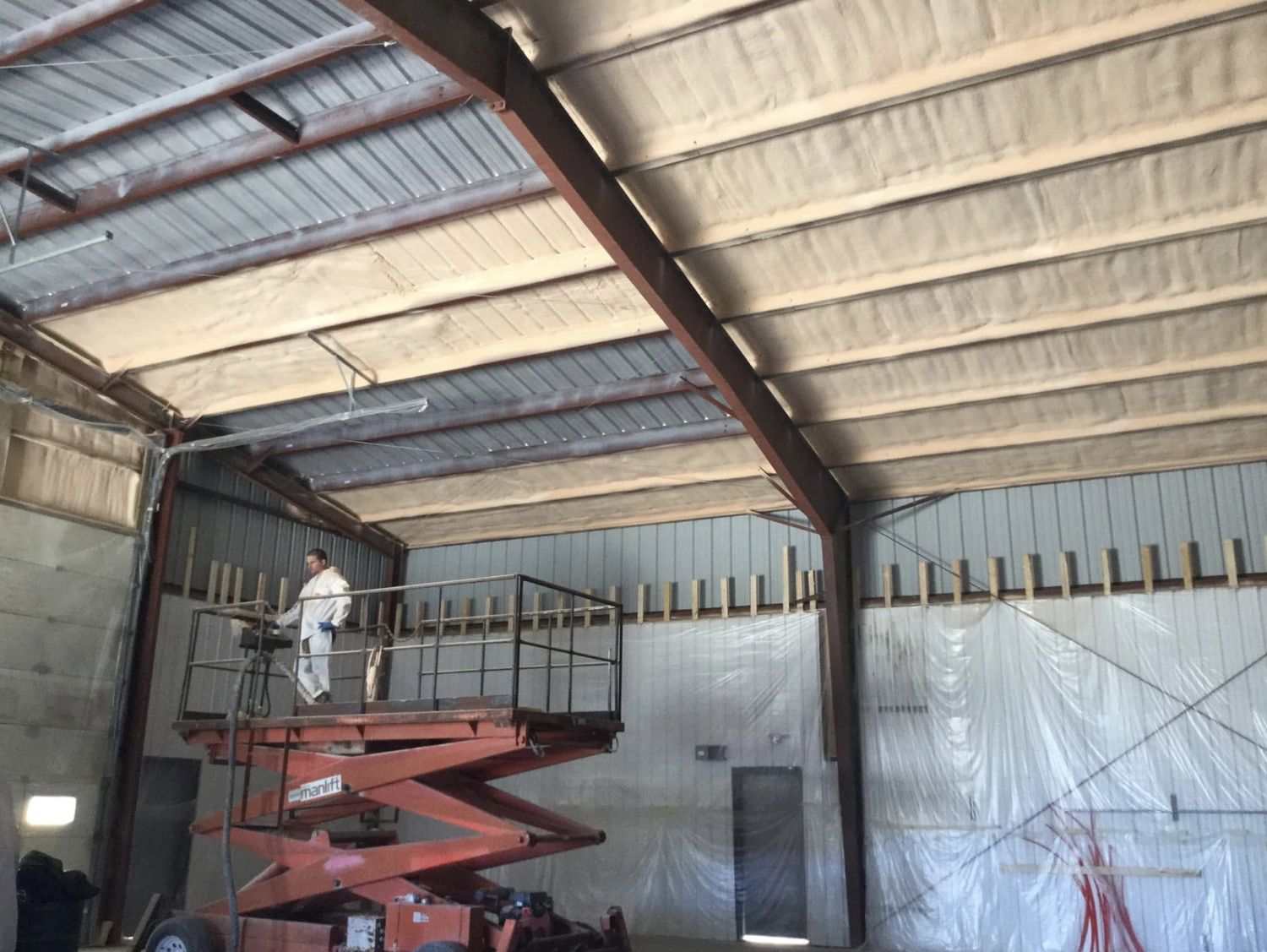
Industrial work runs on your schedule, not ours. We plan to a shutdown or turnaround window when there is one, and phase around running lines when there isn't. The fixed constraints: the work area must be unoccupied and segregated during application, and re-occupancy is 25 hours after spraying with ventilation, per the CCMC listing. The clock applies to each sprayed area, so the rest of the plant keeps running. Those numbers go in the quote so operations can plan against them.
Documentation is the same set our commercial clients get, because industrial owners need it more: daily work records per CAN/ULC-S705.2 covering substrate conditions, pass thickness and density; the CCMC 14133-L product listing behind every quoted R-value; $2M liability coverage and CUFCA photo ID for everyone on your site. On jobs over 9,999 kg of foam, CUFCA requires a third-party inspection. Large industrial scopes reach that threshold, so the biggest jobs carry independent verification on top of our own testing.
Service area is the whole province. The rig is self-contained, and a plant yard outside Brandon is as workable as a warehouse on Inkster.
What lands in the owner's file
Daily records. Substrate temps, pass thickness, density checks, logged per CAN/ULC-S705.2.
Product listing. CCMC 14133-L, the basis of every R-value quoted.
Coverage and ID. $2M liability; CUFCA photo-ID installers.
Third-party inspection. Mandatory over 9,999 kg of material. Independent of us, reported to CUFCA.
Coatings specified and applied where exposure requires them: one contractor, one schedule, one file.
04 Questions
Industrial work, answered
Can you insulate tanks and vessels?
Yes. Foam conforms to curved shells, saddles, nozzles and manways with no fasteners into the vessel: a verified R-11.1 per 2 inches, and a seamless vapour barrier at that thickness, which is what stops sweating on cold contents. Outdoor tanks get a protective coating over the foam.
Sources: CCMC 14133-L
Does spray foam work for cold storage?
It works well, because cold storage is a vapour problem as much as a thermal one. A fully-adhered, low-permeance layer with no seams keeps moist air from reaching the cold side, where fibre systems ice up and fail. Thickness follows the design temperature and is stated on the quote.
Can you work to a shutdown schedule?
That's the normal industrial pattern. We plan to your window or phase around running lines. Fixed constraints: sprayed areas are unoccupied and segregated during application, re-occupied 25 hours later with ventilation, per area. The sequence goes in the quote.
Source: CCMC 14133-L time-to-occupancy listing
How is industrial work priced?
By scope, after a site visit: geometry, thickness, prep, coatings, access and the schedule window set the number. Prairie material rates run roughly $1.35–$2.50 per board foot installed. Written quote with measured surfaces, thickness and verified R.
Bring us the asset and the window. We'll bring the plan.
Site visit, scope-based quote, schedule commitment in writing.