Residential · Garages, Shops & Bonus Rooms
Garage insulation in Winnipeg
Direct answer
A garage in Winnipeg is only worth insulating if you know what it's for. Heat it (as a shop, a winter workspace, or an attached garage you want above freezing) and insulation is what makes the heating affordable across 5,670 heating degree-days. Closed-cell spray foam (R-11.1 at 2 inches, CCMC 14133-L) insulates and air-seals the walls and ceiling in one pass, and on an attached garage the same foam seals the shared wall against exhaust fumes reaching the house. Two things we say before quoting: code requires foam be covered with a thermal barrier like drywall in garages, so budget for board; and an unheated detached garage rarely justifies insulation at all. Ecologic installs to CAN/ULC-S705.2 and quotes in writing.
Sources: CCMC 14133-L · NECB Table C-1 (zone 7A) · NBC 2020 (verified July 2026)
01 The economics
Heat follows the walls out. Insulation is what your heater is for.
An uninsulated garage with a heater in it is a machine for warming the neighbourhood. Bare studs, sheet steel or single-layer OSB hold nothing back, and Winnipeg gives that assembly 5,670 heating degree-days a year to leak through. Owners discover this the first winter they try to keep a shop at working temperature and watch the heater run without stopping.
The order of operations matters. Insulate first, then size the heat. A sealed, foamed double garage holds temperature with a fraction of the output an uninsulated one demands, and it recovers fast after the overhead door cycles. Closed-cell foam earns its place here because garages are hard on materials: temperature swings, humidity from snow-covered vehicles, and walls you'd rather not fill with framing. The foam bonds to the sheathing, insulates at R-11.1 per 2 inches (R-17.5 at 3), and stops the air movement that fibre never does.
Bigger rural buildings (quonsets, machine sheds, pole barns) run on the same physics at a different scale. That work lives on our quonsets, shops and barns page.
02 The surfaces
Four places garage heat goes, in the order they usually matter.
Walls
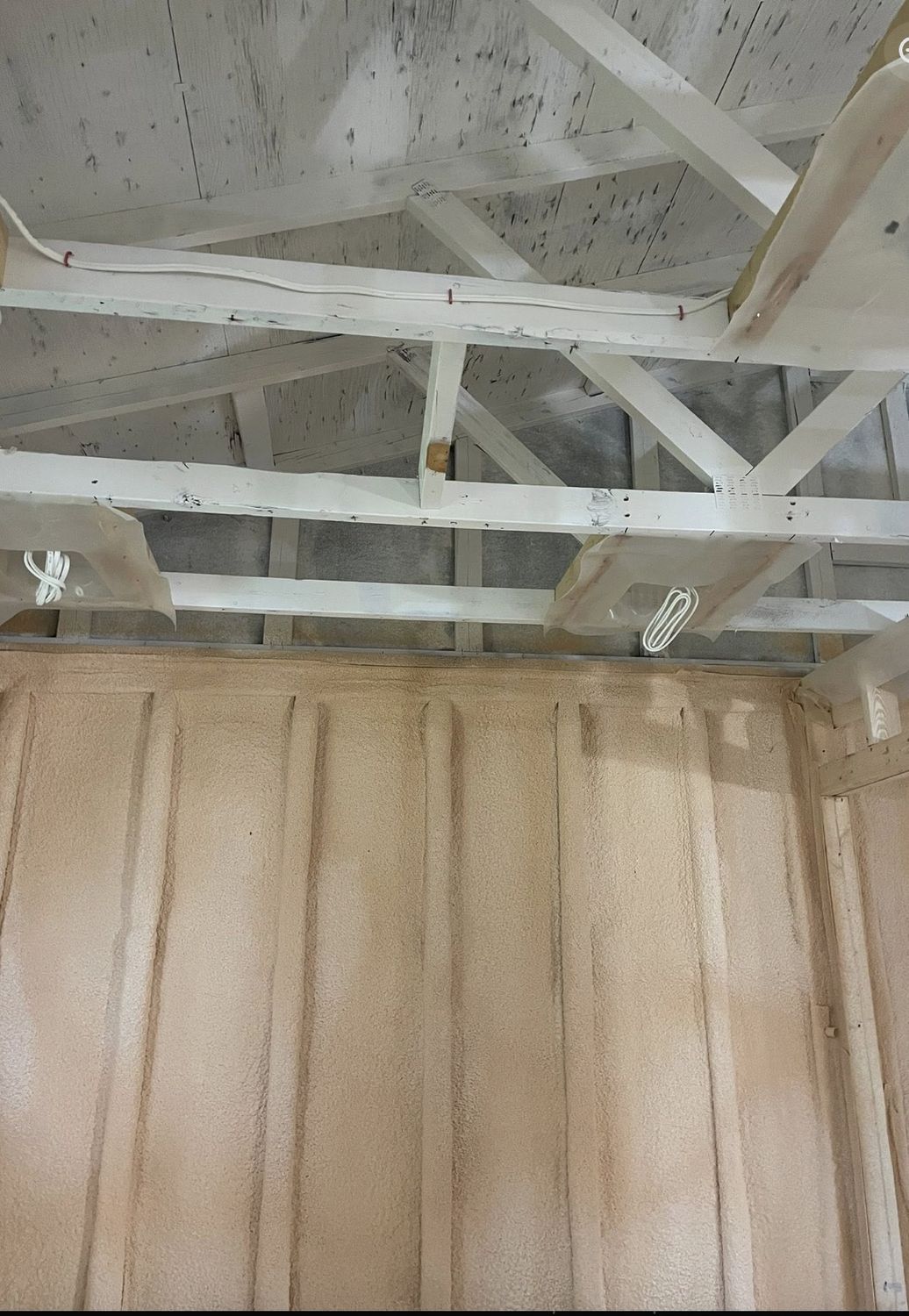
Closed-cell into the stud bays or against the sheathing: 2 inches for a shop held above freezing, 3 inches (R-17.5) if you heat to room temperature, in line with the zone 7A wall target of roughly R-17 effective (with HRV). The air seal does as much work as the R-value.
Ceiling or roof deck
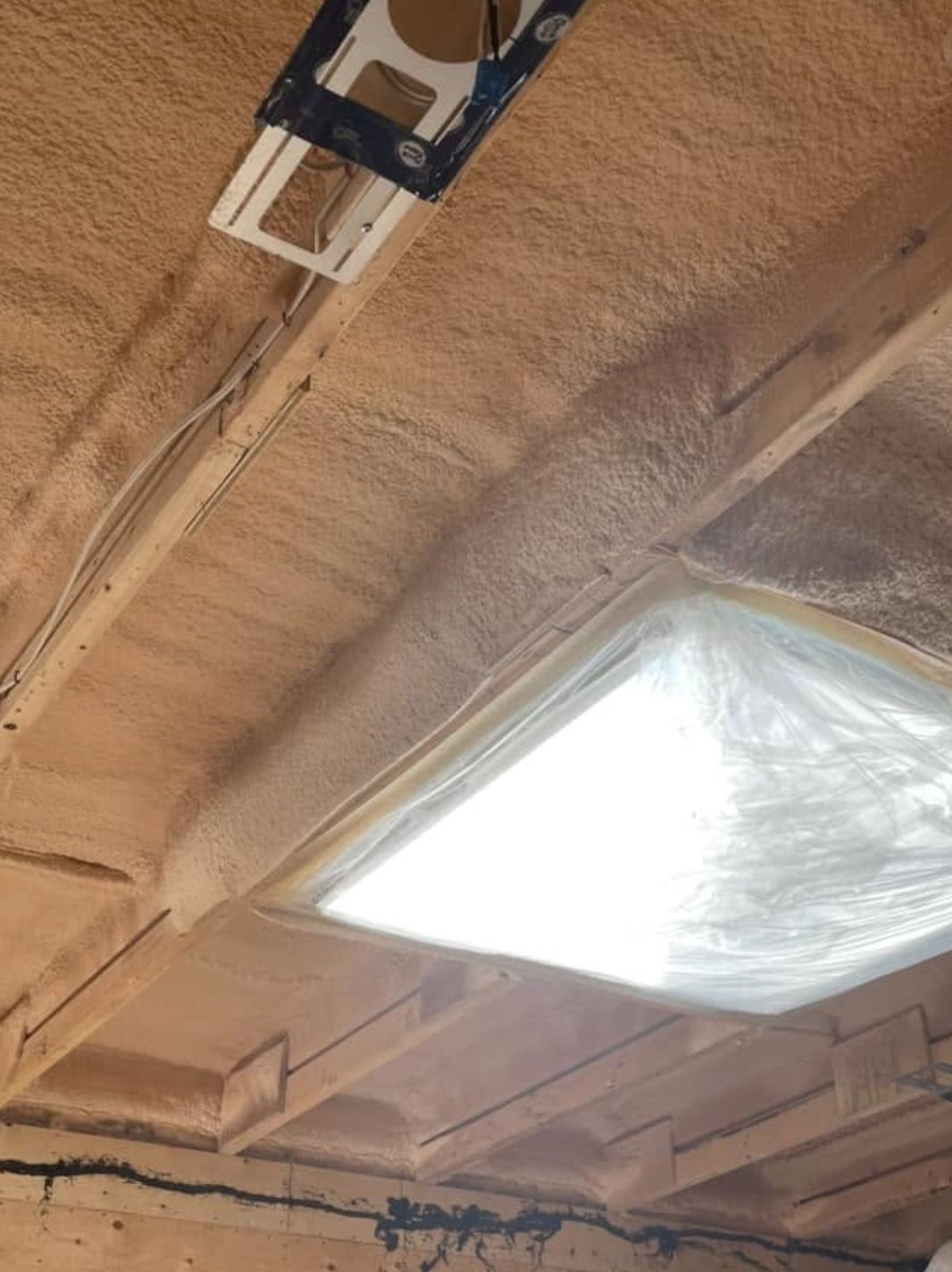
Heat stacks at the ceiling, so it leaks there hardest. A flat ceiling below an attic can take conventional depth; a cathedral or shallow-slope garage roof is closed-cell territory, sprayed to the deck.
Bonus room floors
The room over the garage is cold because its floor hangs over garage air and wind washes through the batts in the joist cavities. Foam against the underside of the subfloor, sealed to the rim and cavity ends, fixes the floor from the garage side, without tearing the room apart.
Slab edge and rim
The slab perimeter and the rim over the foundation bleed heat at floor level, the cold-feet zone. Sealing the rim is the same job we do on rim joists house-wide; the slab edge gets addressed where access allows.
03 Code and candour
Two things most garage quotes skip.
The drywall isn't optional. Code requires foam plastics in garages be covered with a thermal barrier, and drywall is the standard answer. The requirement gets no looser where the garage touches living space. An attached garage also has to keep vehicle exhaust out of the house, which is a code matter in its own right; fully adhered closed-cell on the shared wall and the ceiling below a bonus room seals those assemblies as it insulates. Budget the foam and the board together. A quote that leaves the foam exposed is leaving you with an unfinished, non-compliant garage.
The door matters more than people think. An overhead door is the biggest hole in the building, and a bottom-of-the-line door in a foamed garage is a thermal bypass you paid to frame. If your door is an uninsulated single-skin panel with daylight at the weatherstripping, some of your budget belongs there, and we'd rather say so than sell you an extra inch of foam that the door will waste. Insulated door, sealed perimeter, then the envelope numbers behave the way the math says they should.
Attached garage checklist
1. Shared wall and ceiling sealed against fumes; foam does this as it insulates.
2. Thermal barrier (drywall) over all foam surfaces.
3. Bonus room floor cavities sealed at rim and ends.
4. Door and weatherstripping rated for the heated space.
We spray to thicknesses that leave room for the board, and we document what went where.
04 When not to
The garage we'll talk you out of insulating.
An unheated detached garage gains almost nothing from insulation. With no heat source, the interior drifts to outdoor temperature either way; insulation just slows the drift by a few hours. If the building's job is keeping snow off a vehicle, spend the money elsewhere. If you're insulating because you plan to heat it someday, add the heat plan to the same budget and do both, or wait.
Where the line sits: attached garages usually justify the work even unheated, because the shared wall and any bonus room above are part of the house's envelope and the fume-sealing has value on its own. Detached and heated is a clear yes. Detached, unheated, no plans? Keep your money. We put this in writing on quotes too.
| Garage | Worth insulating? |
|---|---|
| Heated shop or workspace | Yes — insulation is what makes heating affordable |
| Attached, bonus room above | Yes — the floor above is living space |
| Attached, unheated | Usually — shared wall, fume sealing, tempering |
| Detached, heated occasionally | Depends on use — talk it through |
| Detached, never heated | Rarely — no heat to keep in |
05 Questions
Garages, answered
Is insulating a garage worth it in Winnipeg?
If you heat it, yes. An uninsulated heated garage in a 5,670 heating-degree-day climate leaks money through every wall, and insulation is what makes the heating bill survivable. If it's attached but unheated, insulation still tempers the space and protects the shared wall. If it's detached and unheated, insulation does very little; there's no heat to keep in. Decide what the garage is for first, then insulate to match.
Can spray foam be left exposed in a garage?
Generally no. Code requires foam plastics be covered with a thermal barrier (drywall is the usual choice) in garages and wherever foam adjoins living space. Budget for board and taping when you budget for foam. We spray to a thickness that leaves room for the covering, and we'll tell you plainly if a plan leaves foam exposed where it shouldn't be.
How do I keep a bonus room over the garage warm?
Fix the floor assembly, because that's almost always the failure. The bonus room floor hangs over garage air, and wind washes through or around the batts in the joist cavities. Closed-cell foam sprayed against the underside of the bonus room floor, sealed to the rim and the cavity ends, stops the air movement and insulates in the same pass. It's applied from the garage ceiling side, so the room above isn't torn open.
What R-value does a heated garage need in Manitoba?
Depends what you keep it at. For a shop held above freezing, 2 inches of closed-cell (R-11.1, plus the air seal that matters just as much) does the working. For a garage heated to room temperature, aim near the new-construction wall target of roughly R-17 effective with an HRV in zone 7A, which 3 inches of closed-cell meets on the wall. The ceiling matters more if there's living space above it.
Sources: NBC 2020 9.36 (zone 7A, with HRV) · CCMC 14133-L
What does garage insulation cost in Winnipeg?
Closed-cell runs $1.35–$2.50 per board foot installed in Prairie markets. Shape of the math, not a quote: a 24 × 24 double garage has roughly 700 ft² of wall after doors; at 2 inches that's about 1,400 board feet, or roughly $1,900–$3,500, before drywall. A bonus-room floor is a smaller, separate calculation. We quote in writing from measured surfaces, and we'll tell you if your money is better spent on the overhead door first.
Build the shop you can afford to heat.
Measured surfaces, written quote, and a straight answer if the door should come first.