Cottage & Rural · 4-Season Conversions
Cottage and cabin insulation in Manitoba
Direct answer
Most three-season Manitoba cottages can be converted to year-round use, but insulation is only part of the job. Four things have to change: the walls (thin 2×4 framing needs high R per inch; closed-cell foam delivers a verified R-17.5 at 3 inches, CCMC 14133-L), the floor or crawl space, the skirting around a pier foundation, and freeze protection for water lines. Closed-cell spray foam handles all four surfaces, air-seals the leaky shell of an older cabin, and gives mice nothing to nest in. Ecologic sprays cottages across the Whiteshell, Lac du Bonnet, the Interlake, Gimli and the east side of Lake Winnipeg. Book spring or summer. This work has to be finished before freeze-up, and fall fills fast.
Sources: CCMC 14133-L · CAN/ULC-S705.2 · NBC 2020 zone 7A (verified July 2026)
01 The conversion
A 4-season cottage takes four separate jobs.
A three-season cottage was built to be comfortable from May to October. Making it work in January means changing four things, in roughly this order: the crawl space or skirting, so wind can't run under the floor and freeze the plumbing; the floor itself, if the space below stays cold; the walls; and the ceiling. Insulation that skips one of the four leaves you with a heated building and frozen pipes anyway.
Cottage country shares Winnipeg's climate zone: 7A, 5,670 heating degree days. There is no milder standard for the lake. A wall that fails in River Heights fails in Victoria Beach, usually worse, because the cottage sits in open wind off the water.
We spray cottages across the Whiteshell, Lac du Bonnet and the Winnipeg River system, the Interlake, Gimli and the west shore, and the east side of Lake Winnipeg: Grand Beach, Victoria Beach, Hillside and up the 59. One rig, one crew, one trip. Remote sites are why the job gets scoped by phone and photos before we drive out.
The four surfaces of a conversion
1. Skirting / crawl space. Seal the perimeter so wind stops stripping heat from under the floor. This is where water lines live and die.
2. Floor. If the space below can't be kept warm, foam the underside of the floor and the plumbing runs.
3. Walls. Old cabins are 2×4 or less. High R per inch is the only way to a warm wall without reframing.
4. Ceiling. The biggest heat-loss surface once the walls are fixed.
Heating, water supply and septic rated for winter are separate trades. We'll tell you plainly which parts of the conversion are ours and which aren't.
Watch a remote install
 EcoLogic On Site: Portage la Prairie, Manitoba
A remote new-build installation, and what mobilizing the rig outside the city actually looks like.
02 Thin walls
A 2×4 cabin wall has 3.5 inches to work with. Use them.
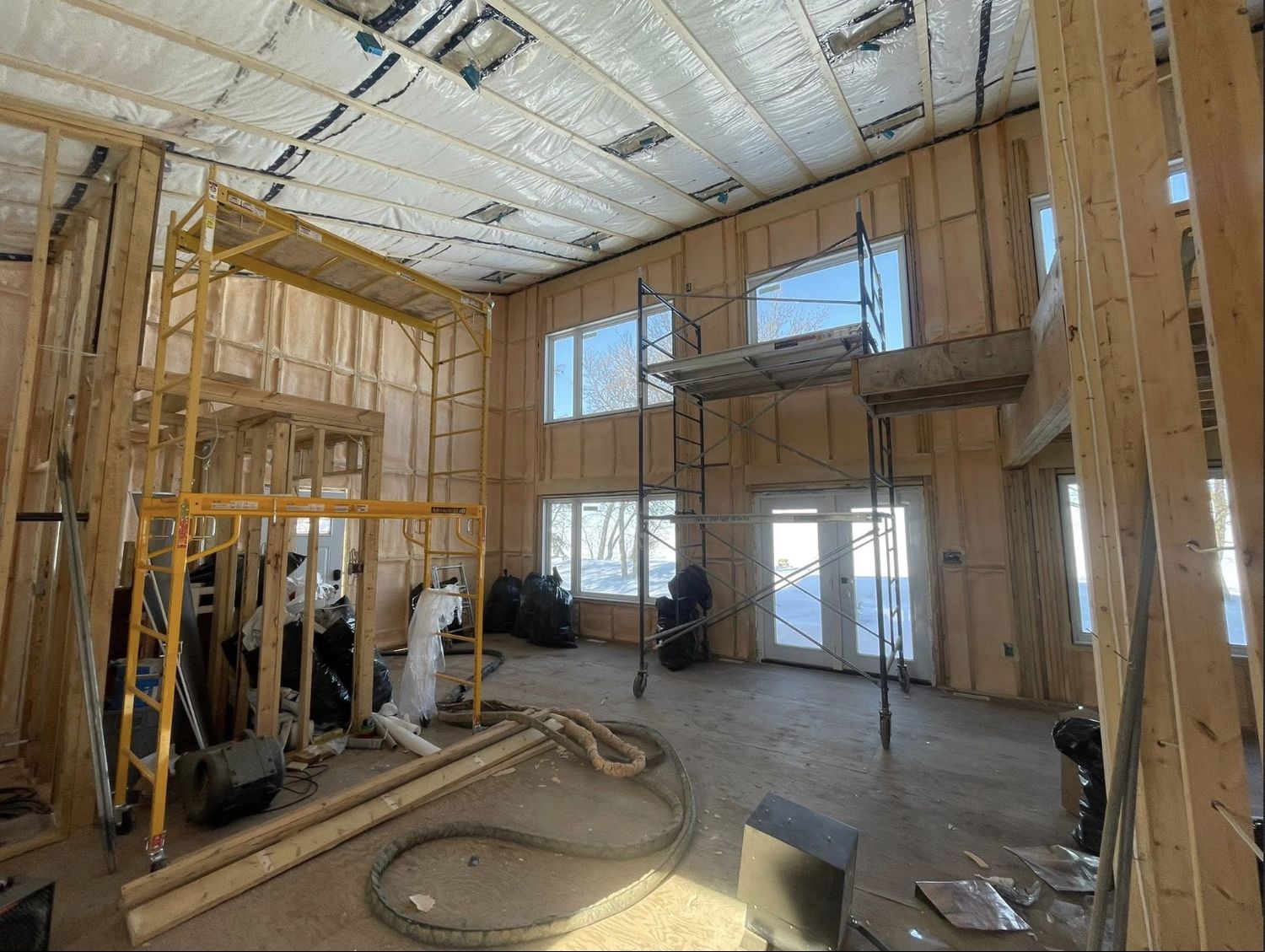
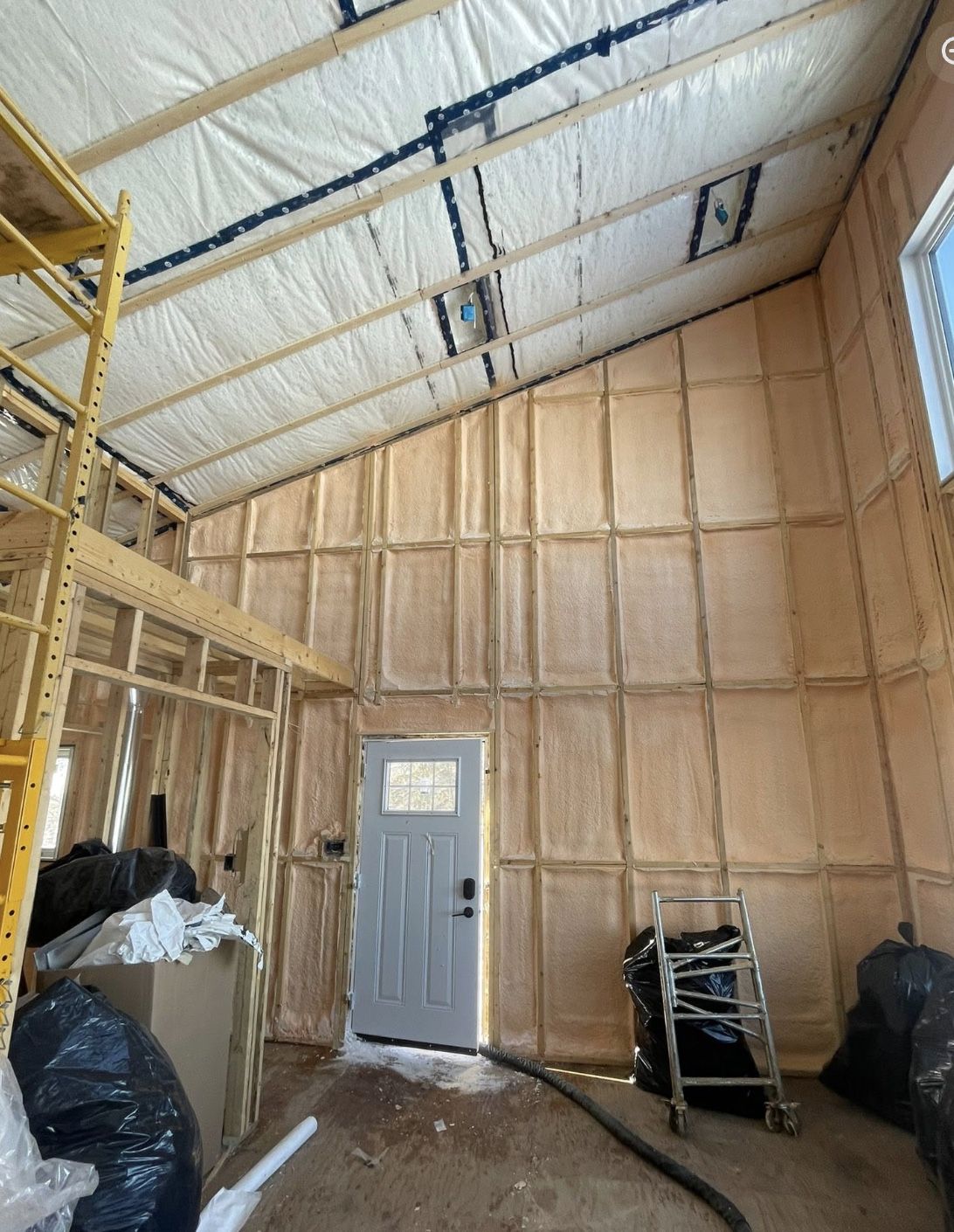
Most Manitoba cabins were framed with 2×4 walls, and plenty of older ones have nothing in the cavity at all. Reframing to 2×6 means gutting the interior. The alternative is to put the highest verified R-value per inch into the space that exists: closed-cell spray foam at R-5.3 to R-6.0 per inch depending on thickness (per-inch LTTR rises with depth; CAN/ULC-S770-15, CCMC 14133-L), against roughly R-3.5 per inch for fibreglass batt.
The foam does two more things a batt can't in a cabin wall. At 2 inches it is the vapour barrier (design permeance 39 against the code limit of 60), which matters because old cottage walls rarely have poly, and opening them up to add it is most of the cost of a renovation. And it is an air barrier: wind off the lake stops moving through the wall assembly. In an old cabin the air leakage is usually a bigger comfort problem than the missing R-value.
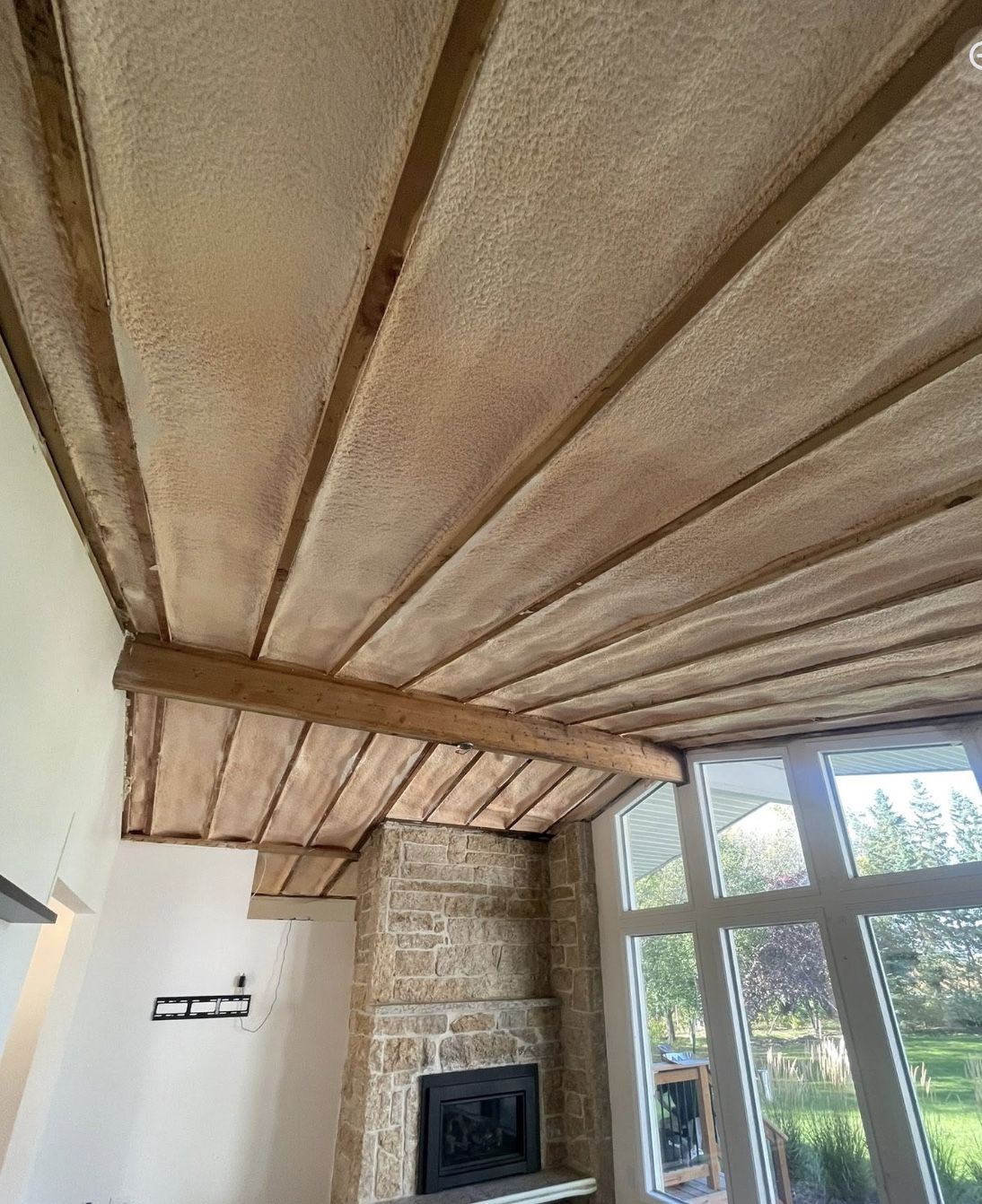
The same logic covers cathedral ceilings and shed roofs with shallow rafters, common cottage framing where loose-fill has nowhere to sit. See closed-cell spray foam for the full material specification.
| Cavity | Closed-cell fill | Cavity R (LTTR basis) |
|---|---|---|
| 2×4 wall | 3 in | R-17.5 |
| 2×4 wall, full | 3.5 in | ≈ R-21 |
| 2×6 wall | 5 in | ≈ R-30 |
| Vapour barrier threshold | 2 in | Permeance 39 (limit 60) |
Tested LTTR ladder: R-11.1 at 2 in, R-17.5 at 3, R-24.1 at 4 (CAN/ULC-S770-15, CCMC 14133-L); intermediate depths estimated. Whole-wall effective R is lower once framing is counted. We show that math on your quote rather than just the cavity number.
03 Under the cottage
Cottages freeze from the bottom up.
Most cottages sit on piers, posts or a shallow perimeter wall with skirting around the gap. Wind moves freely under the floor, and everything down there (water line, drain trap, pump) sits at close to outdoor temperature. This is where winterizations fail. An owner insulates walls and ceiling, holds the building at 18°, and still loses the plumbing in the first cold snap because the lines run through an unsealed crawl space.
The fix is to treat the skirting or crawl space perimeter as a wall: closed-cell foam sprayed to the inside face, sealed at the ground and at the floor framing above. Foam bonds to the rough surfaces down there, rock and block and treated plywood, where rigid board leaves gaps and batts fall down wet. The rim joist, where floor framing meets the perimeter, gets sealed in the same pass.
On mice: cured foam is not food and has no fibre to strip for bedding, and it seals the entry gaps rodents use. Batts in a cottage crawl space become mouse habitat almost immediately; foam takes that away. It is not rodent-proofing by itself (no insulation is), but it removes both the nesting material and the easy ways in. Details on full crawl space work are on the crawl space page.
04 Strategy
Heat it all winter, or drain it down. Decide this first.
Leave it heated. The building holds 5–10° while you're away, plumbing stays live, and you arrive to a cottage that's usable in an hour. This is what a true 4-season conversion buys. It only makes economic sense when the shell is tight enough that holding temperature costs little, which is exactly what the insulation work is for. Budget for the conversion and for the winter hydro or propane that follows.
Drain it down. Water off, lines blown out, antifreeze in the traps, heat off. Cheap insurance, and the right answer for owners who come out twice a winter. Insulation still helps: a tighter cabin warms up in hours instead of a day, and an insulated crawl space protects whatever can't fully drain. But you don't need the full conversion to make drain-down work.
Where we'd talk you out of it. A cabin used two or three weekends a winter may not repay a full 4-season conversion. The honest move might be skirting, rim joists and a drain-down routine at a fraction of the cost. We'll price both and tell you which one your usage justifies.
Efficiency Manitoba insulation rebates apply to year-round primary residences. If the cottage is your primary home, or is about to become it, ask us whether your property qualifies before we quote. We won't promise a rebate a seasonal property can't get.
Booking window
May–June. Best access, full choice of dates, foam cured and closed in long before frost.
July–August. Still good. Scope by phone and photos first so the trip out counts.
September. The rush. Substrate temperatures per CAN/ULC-S705.2 still workable, calendar tight.
After freeze-up. An unheated cabin usually can't meet installation temperature requirements. We'll say no rather than spray a job that won't cure right.
Retrofit areas can be re-occupied 25 hours after spraying, ventilated per the CCMC listing. Plan the closing weekend around it.
05 Questions
Cottages, answered
Can a 3-season cottage become a year-round home?
Usually, yes. Insulation is one piece of a four-part job: walls that hold heat at -35°, an insulated floor or crawl space, sealed skirting, and freeze-protected water lines. Closed-cell foam covers all four surfaces at a verified R-11.1 per 2 inches and air-seals the shell in the same pass. Heating, water and septic rated for winter are separate trades; we'll tell you which parts are ours.
Sources: CCMC 14133-L · NBC 2020 zone 7A
What does it take to winterize a cabin in Manitoba?
Work from the bottom up: crawl space or skirting first (that's where pipes freeze), then floor, walls, ceiling. Two inches of closed-cell is a vapour barrier in itself (design permeance 39 vs the limit of 60), so old walls with no poly can be upgraded without gutting the cabin. Decide heat-on versus drain-down before you spend; it changes what's worth doing.
What's the best insulation for a cottage crawl space or skirting?
Closed-cell foam on the inside of the skirting or crawl space perimeter. It bonds to rock, block and rough lumber, stops wind-washing under the floor, and tolerates damp ground that ruins batts. Fibre down there sags, wicks and turns into mouse bedding.
Do mice nest in spray foam?
Cured foam isn't food and has no loose fibre for bedding, and it seals the gaps mice enter through, a real improvement over batts, which mice strip and tunnel through. But no insulation is rodent-proofing by itself: a determined mouse can chew foam, and open paths elsewhere in the building stay open. The honest claim is a sealed shell with nothing worth nesting in.
When should I book cottage work?
Spring or summer. Installation to CAN/ULC-S705.2 has substrate temperature requirements an unheated November cabin can't meet, and fall is our busiest season. Call in May and you pick your week; call in October and you're hoping.
Source: CAN/ULC-S705.2 installation standard
Get the cottage done before freeze-up.
Scope by phone and photos, one trip out, written quote for conversion and drain-down options both.