Residential · Crawl Spaces & Encapsulation
Crawl space insulation and encapsulation in Winnipeg
Direct answer
Cold floors over a crawl space almost always trace to two failures: outside air moving through a vented, uninsulated crawl space, and ground moisture keeping everything under the house damp. In Winnipeg's climate zone 7A the fix is to seal the crawl space rather than ventilate it: close the vents, cover the exposed ground, and apply closed-cell spray foam (verified R-11.1 at 2 inches, CCMC 14133-L) to the foundation walls and rim joist so the crawl space joins the heated envelope. The floor warms up because the space below it stops breathing February air. Ecologic installs to CAN/ULC-S705.2 and closes common radon entry points in the same pass. One caveat up front: if the crawl space takes standing water, drainage gets fixed first. Foam is not a water repair.
Sources: CCMC 14133-L · NRCan "Keeping the Heat In" §6 · Health Canada radon survey 2012 (verified July 2026)
01 The symptom
The floor is cold because the crawl space is outdoors.
A vented crawl space in Winnipeg spends the winter within a few degrees of the outside air. Above it sits your subfloor, often with nothing between the two but a batt someone stapled up decades ago, now sagging out of the joist bays. Everything down there gets cold: the floor, the plumbing runs, the heating ducts if you have them.
Homeowners usually attack the symptom by insulating between the floor joists. It rarely satisfies. Air finds the gaps around the batts, the pipes stay on the cold side of the insulation, and the crawl space itself is still damp and freezing. The better move is to change what the crawl space is: bring it inside the heated envelope, the way a basement is.
Additions, cottages and older infill houses are the usual owners of Winnipeg crawl spaces. If yours is under a cottage or cabin, the same logic applies with a few seasonal wrinkles.
What a vented crawl space does all year
Winter: outside air chills the floor, the ducts and the water lines. Frozen pipes live here.
Summer: humid air drifts in and condenses on cool ground and cooler concrete.
All year: exposed soil feeds moisture and soil gas upward into the house.
The vents were supposed to dry the space out. In this climate they do the opposite for half the year and freeze it for the other half.
02 The building science
Vented crawl spaces lose in zone 7A. Seal them.
Venting crawl spaces was standard practice for decades on a simple theory: moving air dries things out. Field experience and research pushed the other way. In a cold climate, vents admit exactly the air you don't want (freezing in winter, humid in summer) and the crawl space stays damp anyway, because the moisture comes up from the ground whatever the air is doing.
Current guidance, including NRCan's "Keeping the Heat In," treats the sealed, insulated, conditioned crawl space as the durable assembly: insulate the walls instead of the floor above, cover the ground, and keep the space connected to house air. Winnipeg's 5,670 heating degree-days only strengthen the case. Every cubic foot of outside air you keep out of that space is air you didn't pay to heat around your plumbing.
The insulation itself has to tolerate a crawl space's conditions: intermittent dampness, concrete or block walls, no room to build framed assemblies. Closed-cell foam applied to the wall handles all three, the same way it does on basement foundation walls.
| Condition | Vented | Sealed + insulated |
|---|---|---|
| Winter air in crawl space | Near outdoor temp | Near house temp |
| Floor above | Cold | Warm |
| Pipes & ducts | Freeze risk | Inside the envelope |
| Summer humidity | Condenses inside | Kept out |
| Soil gas path | Open | Sealed at ground & walls |
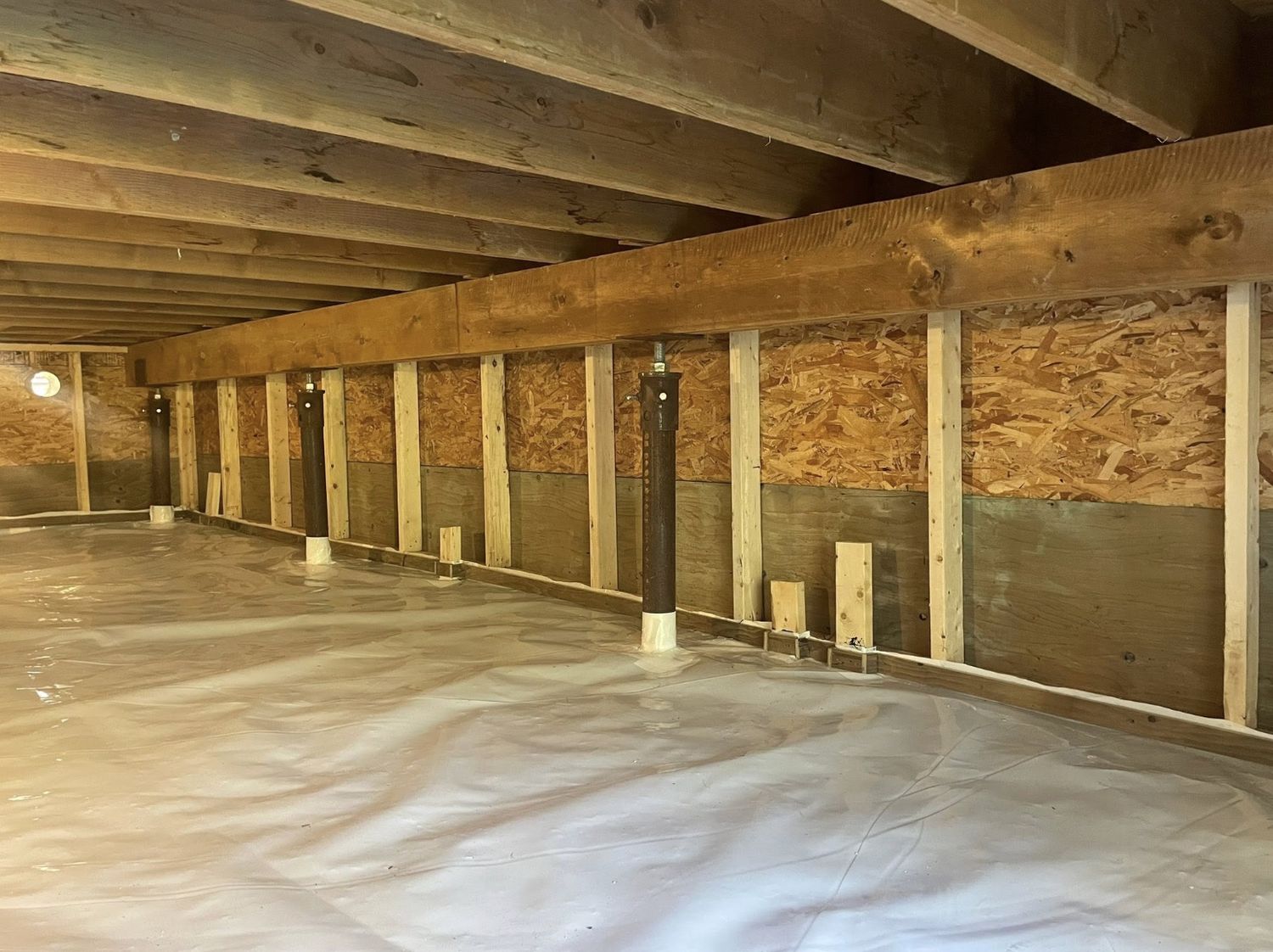
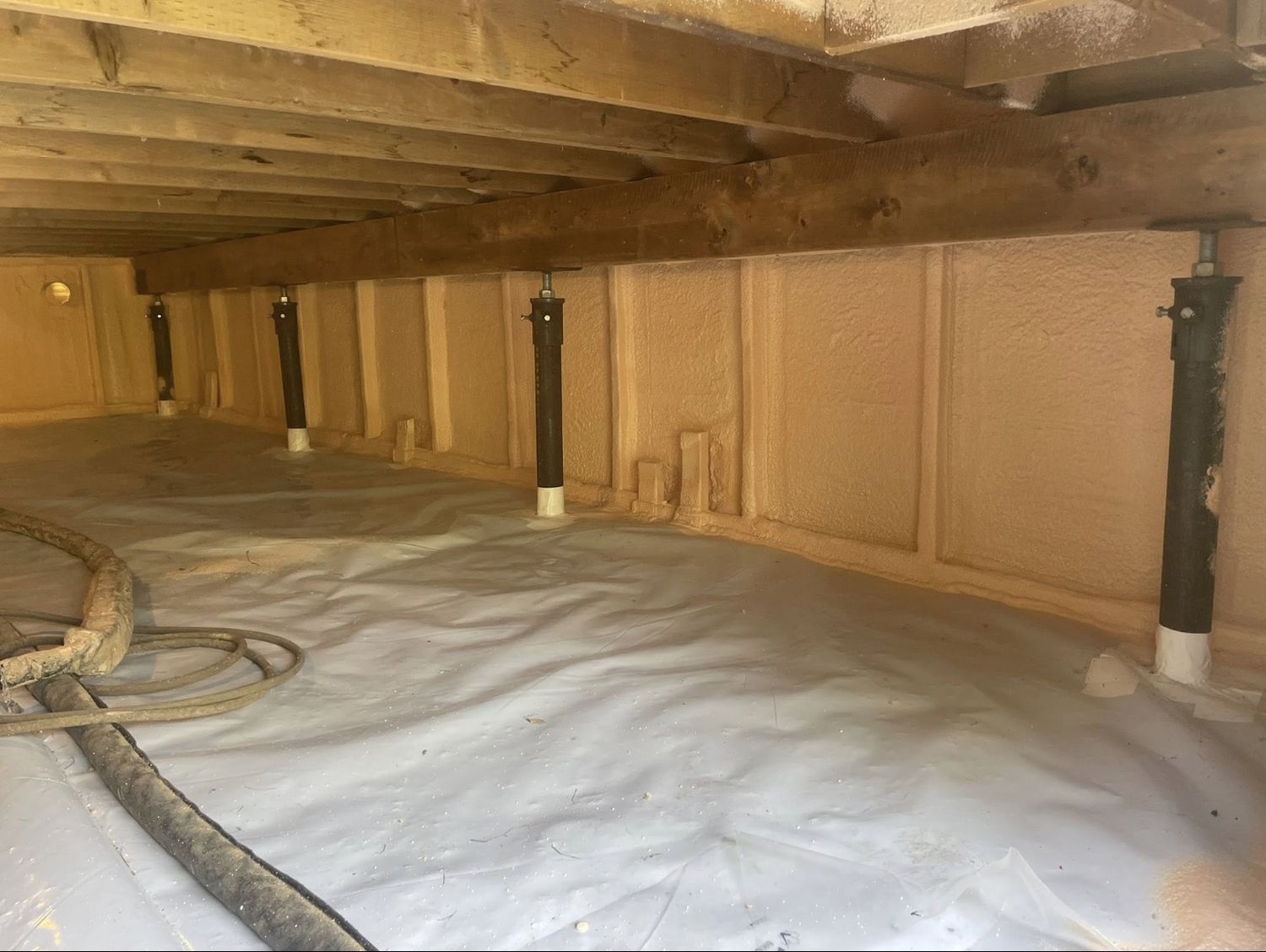
03 The assembly
Encapsulation, in the order we actually do it.
Inspect, and disqualify if needed
We check for standing water, active leaks, grading problems and failed weeping tile. If water gets in, a drainage contractor goes first and we tell you so. Foam over a wet crawl space is money buried in the wrong problem.
Cover the ground
Exposed soil gets a sealed ground cover. This is the single biggest moisture source in most crawl spaces, and it's also the main soil-gas entry plane.
Spray the walls and rim joist
Closed-cell foam on the foundation walls, typically 3 inches toward the zone 7A foundation target of about R-17 effective (with HRV), carried up and over the rim joist, the leakiest wood in the house. At 2 inches the foam is already the vapour barrier (design permeance 39 against the code limit of 60).
Close the vents, condition the space
Vents are sealed permanently and the crawl space gets a small connection to house air so it stays dry year-round. We document thicknesses and locations, with daily adhesion, cohesion and density tests logged under the CUFCA program.
04 Radon, rebates, limits
What sealing buys you, and what it can't do.
Manitoba is radon country. Health Canada's 2012 Cross-Canada Survey found 19% of Manitoba homes above the 200 Bq/m³ guideline, among the highest rates in the country, with some regions over 40%. A crawl space with bare soil and leaky walls is a direct route for soil gas into the house. Encapsulation closes the ground plane and the wall leaks, which is why the same work shows up in our radon gas barrier service. Test first, and treat sealing as support for mitigation rather than a replacement.
On rebates: crawl space walls are foundation walls, and Efficiency Manitoba's insulation rebate pays $0.06 per ft² per R-value added on foundation walls, capped at material cost, pre-approval required before work starts, CCMC-verified R-values only. Eligibility depends on your heat source and existing insulation; we confirm before quoting.
And the honest limits. A crawl space with standing water or a drainage problem is not an insulation job yet. A crawl space you plan to excavate into a full basement shouldn't get this money either. We'll say either of those to your face before we say a price.
05 Questions
Crawl spaces, answered
How do I fix cold floors over a crawl space?
Stop treating the crawl space as outdoors. Close the vents, cover the ground, and insulate the crawl space walls and rim joist with closed-cell spray foam so the space below your floor holds house air instead of February air. Insulating between the floor joists instead almost always disappoints: air leaks around the batts and the pipes below stay in the cold.
Should a crawl space be vented or sealed in Manitoba?
Sealed. Venting was meant to dry crawl spaces out, but in practice it pulls in humid summer air that condenses on cool surfaces and freezing winter air that chills the floor and the plumbing. Current building-science guidance, including NRCan's Keeping the Heat In, treats a sealed, insulated, conditioned crawl space as part of the house. In a 5,670 heating-degree-day climate the vented crawl space loses on every count.
Sources: NRCan Keeping the Heat In §6 · NECB Table C-1
What is crawl space encapsulation?
Sealing the crawl space off from the ground and the outdoors, then insulating it. In practice: vents closed permanently, a ground cover over exposed soil, closed-cell spray foam on the foundation walls and rim joist, and a small supply of house air so the space stays conditioned. The foam insulates at a verified R-11.1 at 2 inches, air-seals from 1 inch, and acts as the vapour barrier at 2 inches. One material does the layers separate products do in other assemblies.
Source: CCMC 14133-L
Does crawl space insulation help with radon?
It helps close entry routes, and that matters here: Health Canada's 2012 Cross-Canada Survey found 19% of Manitoba homes above the 200 Bq/m³ guideline, with some regions over 40%. An open-ground, leaky crawl space is a direct path for soil gas. Sealing the ground and foaming the walls and rim cuts the pathways. It is not a substitute for testing. Test first, and if levels are high, sealing works alongside mitigation, not instead of it.
Source: Health Canada, 2012 · see our radon gas barrier page
What does crawl space insulation cost in Winnipeg?
Closed-cell foam runs $1.35–$2.50 per board foot installed in Prairie markets. As a shape of the math, not a quote: 400 ft² of crawl space wall at 3 inches is 1,200 board feet, or roughly $1,600–$3,000, plus ground cover and sealing work. Crawl spaces are slower work than open basement walls; clearance dictates a lot. Foundation walls can earn an Efficiency Manitoba rebate of $0.06 per ft² per R added, pre-approval required. Written quote after we've actually crawled in.
Warm floors start under them.
Inspection first, including the honest "fix your drainage before you call us back" when that's the truth.